
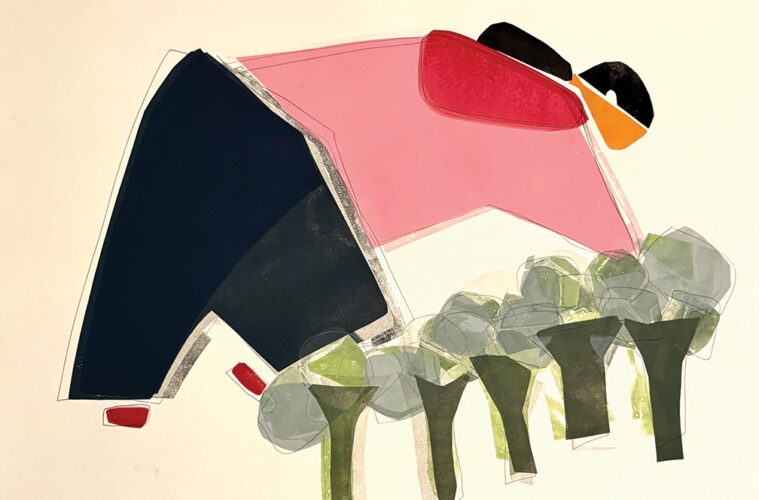
Margaret DeKoven is a Colorado‑based printmaker whose evocative monoprints, woodblock prints, and etchings explore the beauty, strength, and vulnerability of her subjects. From the people she encounters in everyday life, to the natural world that surrounds us, she creates beautiful pieces from inside her studio in Evergreen. Drawing inspiration from street scenes and photographs, her work highlights Indigenous women, migrants, and figures in society through elemental shapes and color, inviting viewers to connect with shared human stories. We were lucky to connect with her for the Month of Print.
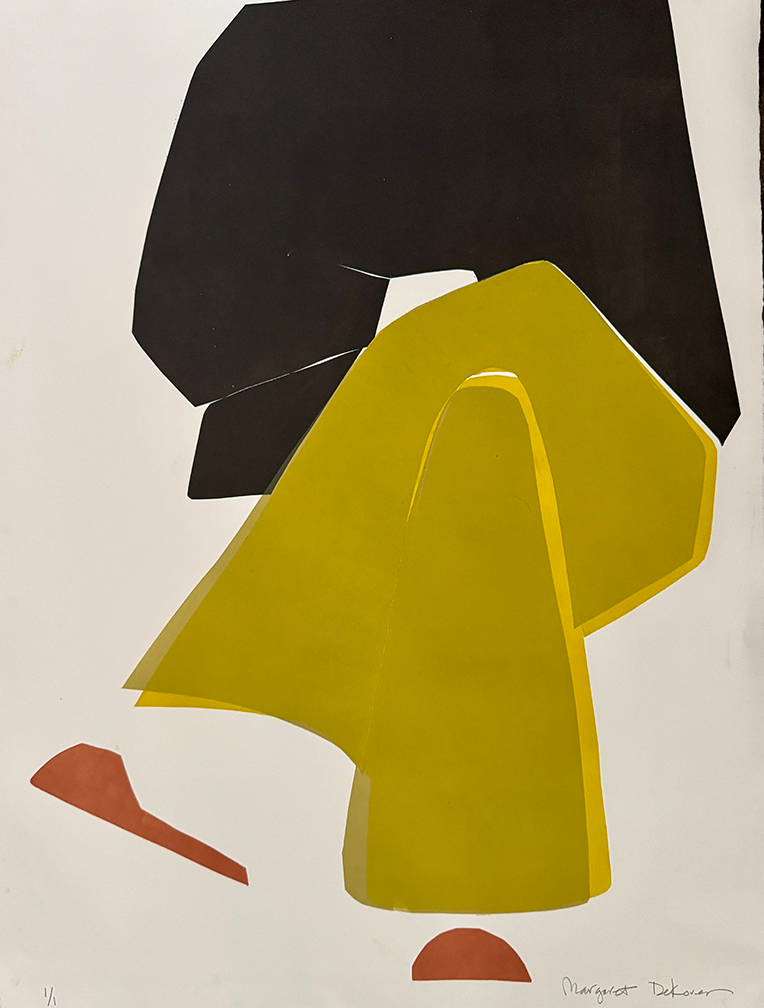 Can you begin by telling us how you began your journey in printmaking?
My journey in printmaking has been a circular one. I am a third generation Coloradan.
When I was in high school in Denver many years ago, I was introduced to the work of Sister Corita Kent and I was transformed. Her graphic screen printed images and her social justice message really moved me. It was then that I became interested in all things printed.
I studied fine arts and printmaking as an undergraduate at CU in Boulder for two years. I then left school for a few years in search of outdoor adventures. When I returned to college, I studied biology, then Pediatric Medicine at CU.
After a 38 year career in Pediatrics, in 2019 I returned to my original love of fine art and printmaking. I am currently a member of the Art Students League of Denver where I have found an amazing printmaking faculty and a vibrant artist community. I also have an etching press and a small studio in my home in Evergreen that overlooks my vegetable garden.
Your work feels bold and deeply tactile. When you begin a new piece, what usually comes first for you, the image in your mind, the process, or the physical act of working the plate?
It is all about shapes for me. I have begun to see everything as shapes. A woman on the street or a figure in a photo may inspire a print just by the forms I see in the image. When I see a compelling figure or scene, it sits with me in my mind for a long time until I decide how I can interpret it in shapes and make it my own on paper. If I see s scene that tells a story I might make a series of prints that can promote that story. I have recently done a series of Campesinos (farm workers). They are beautiful figures and I feel the need to honor their important work in some small way. They literally feed us everyday.
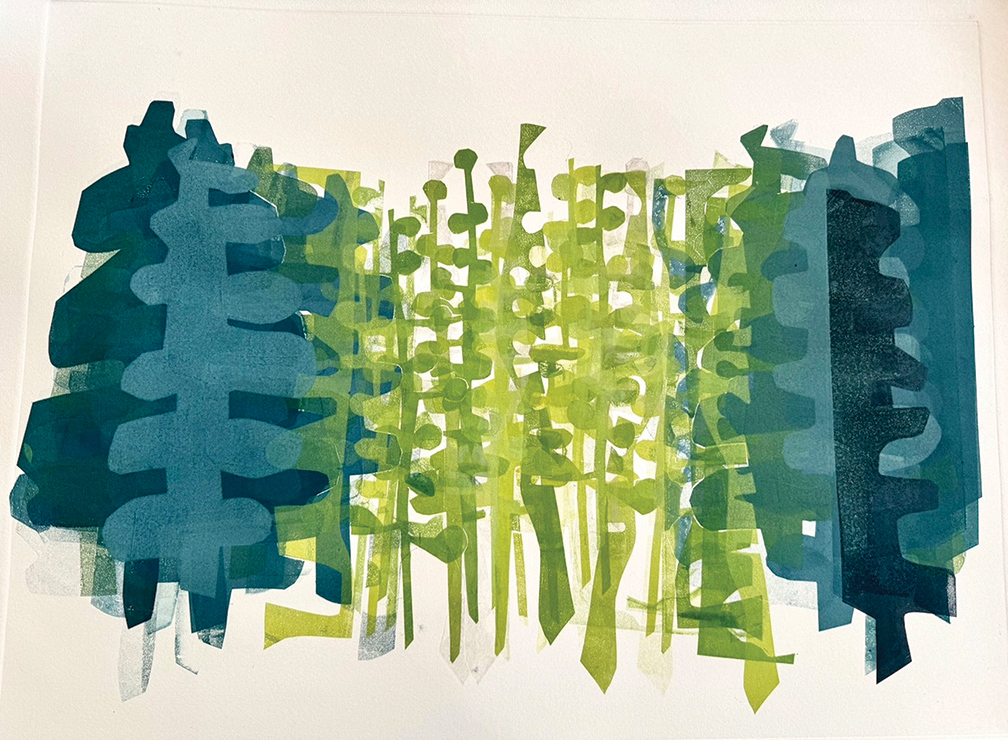 Monoprinting embraces the idea of the one-of-a-kind. What draws you to a process where repetition isn’t the goal, and how do you decide when a monoprint is finished?
My work consists of monoprints, relief prints and etchings. Monoprint is my most used technique and as the name suggests, only one print is made. I love the immediacy and spontaneity of the process. I believe monoprint is perhaps the most intuitive form of printmaking. There is more freedom to make changes along the way and let the image unfold as it wishes. With these, I do not feel the need to create more than one.
When I create relief prints carved from wood or linoleum or make an etching, it requires much more planning for each step in the process and more discipline in a way. The image is finite and direct and repeatable. I can print more than one, but I keep it to a minimum, generally less than ten in an edition.
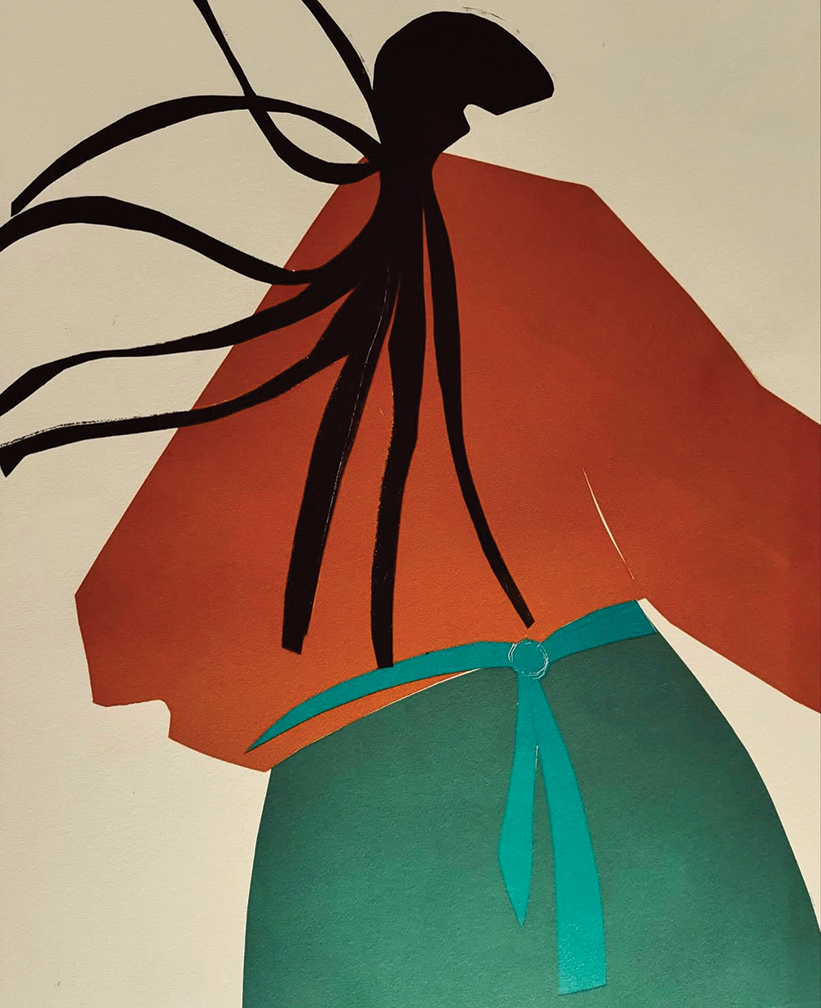 Relief printing requires carving away what won’t be seen. How does that act of removal influence the way you think about composition, negative space, and intention in your work?
That’s a good question. I really enjoy the process of carving an image. It is a very physical act!
Again, it is the shapes that inform my decision regarding negative and positive space. What will be taken away and what should remain? How do the shapes in the image speak up? How to they want to be seen? They speak to me and it’s different every time.
Solar plate etching replaces acids with sunlight and water. Beyond the environmental benefits, how does this process change the physical or emotional relationship you have with the plate?
I learned about solar plate etching from Mark Lunning who is a master printer and faculty at ASLD. I am certainly not an expert, but find the process fascinating. Using sunlight to help etch an image on a metal plate instead of harsh chemicals is a wonder. The image slowly and mysteriously appears as I gently wash water over the plate like the old Polaroid images appear on film. It is a slow and exciting unfolding. I feel a bit removed from the making as I watch the image emerge.
For me, etching is a bit of a risk or a gamble. I may think I know how my drawing will appear as an etching on paper, but I never know until the paper is lifted off the press. It really is a mystery.
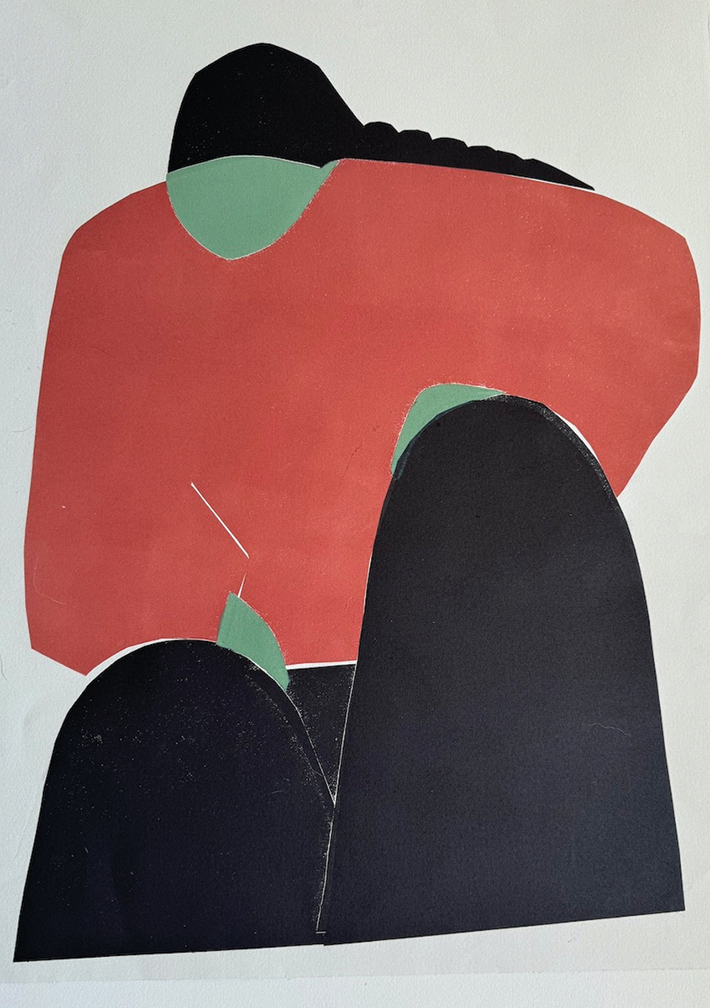 You work across monoprint, relief print, and solar plate etching, three processes with very different rhythms. How does each technique shift your mindset in the studio?
Making a monoprint is very fluid and intuitive. I can begin with an idea, but as the process unfolds, it may become something entirely different. I am informed as I go. It can be a very freeform experience.
With relief print and etching, the process is very different and more controlled. I spend more time in the planning stages, drawing, designing and remembering to think in reverse!
Many of your prints feel simultaneously controlled and expressive. How do you balance precision with spontaneity, especially when working with processes that invite surprises?
My process of designing an image and then cutting shapes to ink up and print is planned and rather controlled. When I place these inked shapes on the etching press and cover them with fine paper, my control is then somewhat surrendered to the press. I slowly crank the press wheel to push the paper through the press, and when I lift the paper to see the print, it is called “ the great reveal“. Always exciting, sometimes disappointing, sometimes a great surprise! At times, this is the end step and the print is finished. Often the print requires more layers or more adjustments. Thats the step where I can really get playful.
Printmaking has such a rich, historical lineage. As a contemporary printmaker, where do you feel most connected to tradition, and where do you intentionally push against it?
I have many books about printmaking and read and research printmaking, it’s history and techniques as much as possible. I really cannot get enough! Perhaps it may be because I did not attend formal art school, I don’t feel bound by tradition. I appreciate traditional historical printmaking due to its incredible precision and discipline, but I don’t feel the need to bow to it. I have the freedom to not follow the rules of traditional printmaking because I didn’t spend years learning them in school. It’s a childlike place to be and I am grateful for it.
March is Month of Printmaking in Denver, a city with a strong print community. What does it mean to you and will you be featuring your work? What do you hope viewers feel when they encounter your prints up close?
The Month of Printmaking (MoPrint) is extraordinary because it brings the city of Denver and the vibrant printmaking community together every two years to celebrate this incredible art form. Everyone in the printmaking community becomes energized.
With great local leadership from printmaker Emily Moyers and many others, we come together to volunteer, plan exhibits, lectures, demonstrations and workshops all over the front range to introduce the public to the fine art of printmaking. This year Mo Print is bigger and better than ever. Come see!
My work will be featured in several exhibits around town:
528.0 “Futures” Regional Print Exhibit
Center for Visual Arts
965 Santa Fe | Denver
January – March
Solo Exhibit
Adorn Objects
1617 Market St. | Denver
February – May
“Eleven by Anything” International Small Prints Juried Show
Spark Gallery
1200 Acoma St. #100 | Denver
February 27 – March 24
“Pressed to Impress“ A Community Print Exhibit
Art Students League of Denver
200 Grant St. | Denver
February 27 – April 11
What can we expect from you in the future?
I have some exciting potential opportunities in the future. Last fall, I was an Artist in Residence at In Cahoots Press in Petaluma California. While there, I met a Berkeley based printmaker Corrine Hatt. We have decided to try to collaborate on some large scale prints this summer in Berkeley at KALA Art Institute. Corrine’s work is largely abstract landscape and architectural in nature. My work has been primarily figurative. We are hoping to combine our styles and find new rhythms to try and create something new. We have some vague ideas, but we will see what emerges. That’s where the magic happens!
Discover more from the world of Margaret DeKoven, where every print tells a story and every figure invites connection. Explore her work and experience the quiet power and beauty she captures at margaretdekovenprintmaker.com.