
 BY SHALEEN DESTEFANO
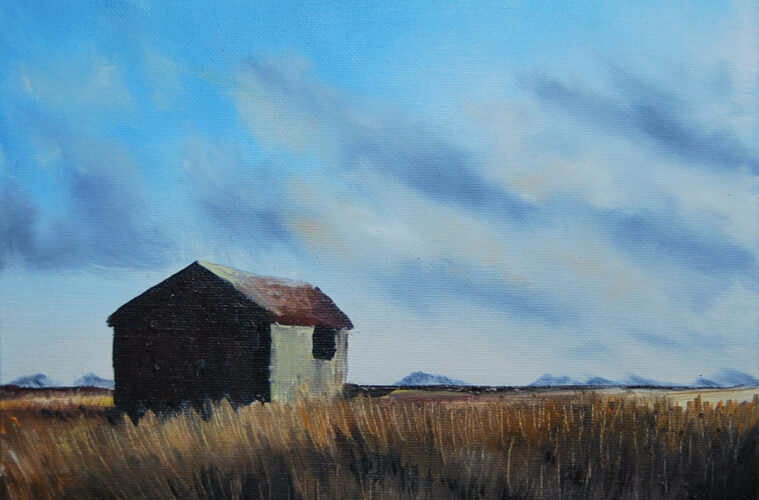
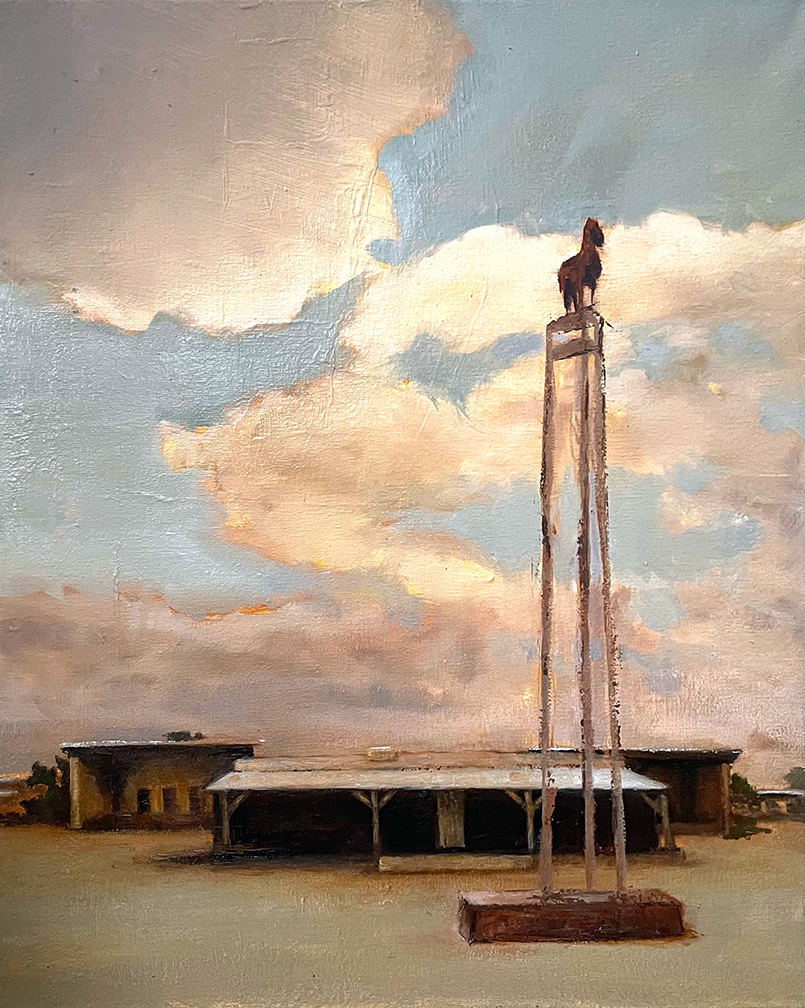
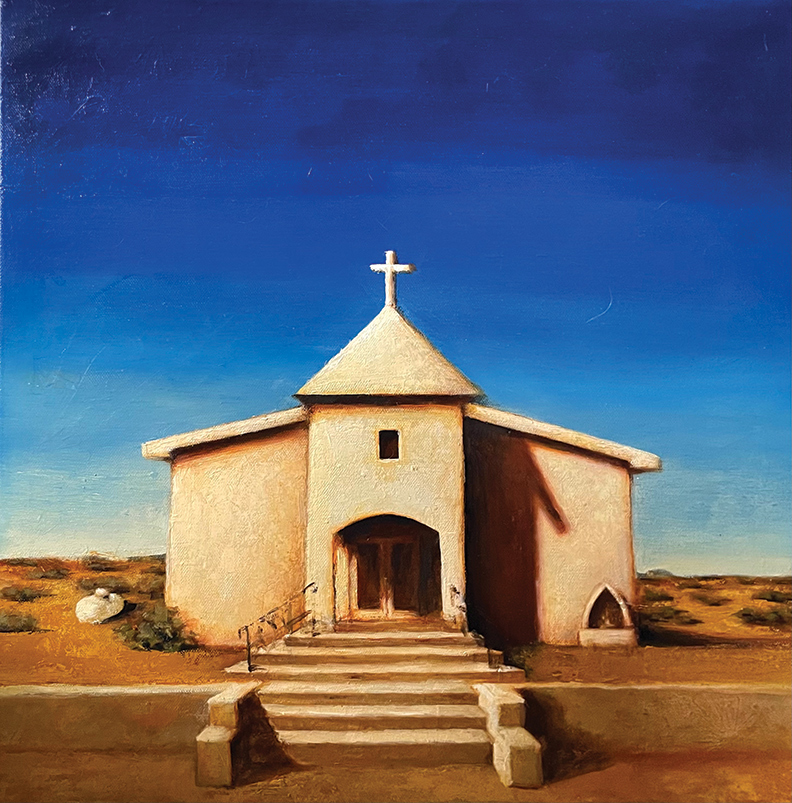
Lyndy Bush is a Native New Mexican oil painter living and working out of her studio in Highlands Ranch, Colorado. She originates from Las Cruces in Southern New Mexico, and her work explores the connection she has with the landscapes of Southern New Mexico and the Colorado Front Range. Specifically, she is interested in exploring the idea of documenting her perspective and lived experiences of beauty, strength, and resilience in this region and adding to the material cultural catalogue of who we are and who is remembered.
Your work is deeply rooted in memory and place. Can you share a specific memory that has shaped the way you see and paint the landscapes of the Southwest?
Almost every weekend, my mom would drive my brother and me from Las Cruces to Truth or Consequences. It’s a 45-minute to 1-hour drive each way with open southwestern landscapes on either side. I was a bookworm, and could have chosen to read books in the backseat, but instead, I would study the mountains and valleys, and the way light fell on them at different times of day and in different seasons. The skies also go on forever. I would study clouds and watch how they moved and morphed through space as they receded into the atmosphere. It was a lesson in observation, and the more I observed these 80 miles of Southwestern skies and landscapes, the more I fell in love with them.
How has your background in Anthropology influenced the way you observe landscapes and translate them into paint?
I believe that anthropology has significantly influenced my intentions behind what I paint and how I approach painting it. I loved learning about cultures through time and space. It was the most interesting thing to do, because you got to study what people loved and created, and in doing so, learn about the heart and passions of a person who lived. Art, in particular, allows you to learn something about humans as a whole by gaining deep insights into their motivations and desires.
As I approach my work, I’m not trying to say anything profound in each of the works I create. I’m just recording the perspective of a single human, myself, living in the United States today. This includes depicting the things I see and attempting to capture them as accurately as possible, while also conveying my feelings about them.
Anthropology has taught me that one function of art is to document and preserve cultural heritage by preserving visual perspectives. The perspectives that have been made tangible through art, literature, invention, and science are naturally the ones that get carried forward through museums and history.
My work is simply suggesting that it could be my perspective. My family, the Southwest, my experiences, my definition of beauty, and my drive to replicate my most authentic perspective through art.
 Your paintings feel immersive and atmospheric while remaining grounded in real places. How do you approach capturing a landscape’s emotional weight without losing its sense of realism?
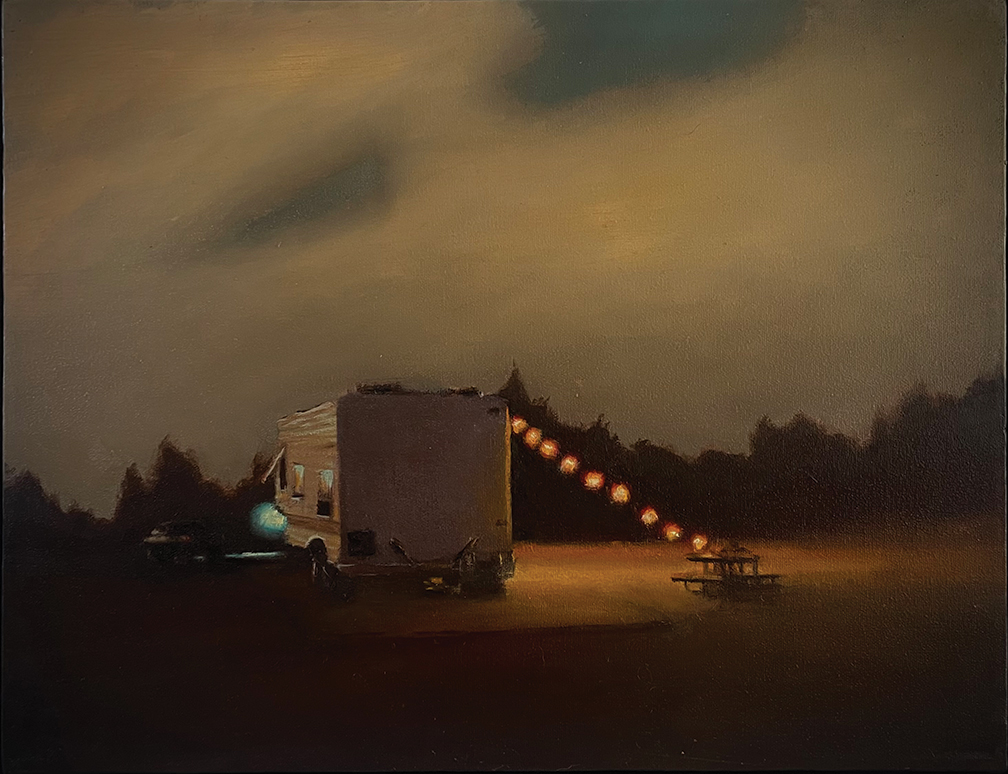
First, thank you for such a thoughtful observation; I think you are pointing to one of the biggest conversations I have with myself while painting. I approach each piece as a challenge, where I’m pulled between capturing the likeness and essence of something I love through the representation of an actual place/thing and balancing it with mystery and abstraction, so that the viewer can fill in the blanks. This middle ground is the most interesting version of my work. The dualistic tension is a sweet spot where I express my vision, and at the same time, invite the audience to contribute the rest.
To accomplish this, decisions must be made on what needs to be included to accurately express my perception of each subject. The more you can leave out, the more you can get the viewer to focus on the subject and emotions I want them to see. Subtracting realism by leaving out essential elements and adding back some selective detail until I hit something that feels right.
Once I obtain those essential pieces, I can then explore enhancing the emotional impact of the piece through depth and color.
 The Southwest often holds both beauty and severity. What draws you to that tension, and what do you hope viewers feel when they spend time with your work?
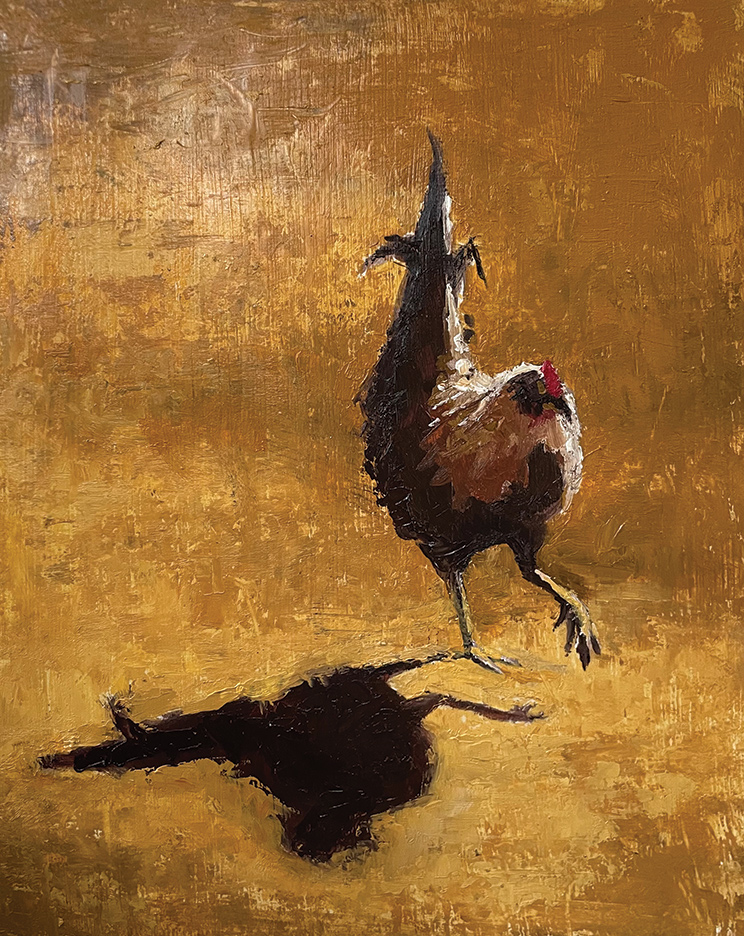
I grew up seeing touristy southwestern art in Southern NM. Think “A cowboy riding a horse through a beautiful canyon at sunset”. As I began exploring the type of work I wanted to create, I developed a strong aversion to painting anything “Southwestern” because it didn’t feel authentic. It was beauty without the severity, and it felt more like a bad advertisement. When I moved to Colorado, I saw it from the outside and noticed the gap between my experience and the art displayed in galleries and museums. What I realized is that the perspective that lovingly presents the severity alongside the beauty was not represented in the dominant art genre. To me, it feels truthful, and I hope others can experience that loving tension when they spend time with my work.
Can you walk us through your creative process, from the earliest spark of inspiration to knowing when a painting is finished?
My art practice has infiltrated my whole life. To start, with the goal of documenting my life, I need to take pictures when I see something that inspires me. This range of what this can be is wide, and I don’t like to stifle it. If it’s beautiful and crosses my path, it has the potential to become a painting at some point. My phone is filled with random images from everywhere I go, and I go through them to see what is calling to me when I’m ready to start a new painting.
I’ll paint studies of the images and sketch them to work out the composition and values. Some never make it past this phase.
By the time I reach a larger canvas, I have usually already figured out the sketch, composition, and overall value structure. I tone the canvas with transparent red oxide to create a burnt orange that sometimes pokes through the paint and rough in the large value shapes, defining the darkest areas and lightest areas to make sure it is visually interesting even without the details of the image, and let it dry.
The next step can be days, months, or even years. It’s the push and pull of color theory and detail through layering and glazing that ultimately lead me to a place where it feels right. Where the painting visuals feel how I felt in the moment when I was there. I choose oil paint for the depth and versatility it allows for complex color manipulation and beautiful translucent effects that speak directly to the colors and depth I see around me.
 You have spoken about growth coming through experimentation and risk. How has that mindset evolved over time, and how does it show up in your studio practice today?
I think artists can be their own worst critics, and if you listen to that voice in the back of your head all the time, you might not ever pick up a brush again. I like to intentionally combat that by showing up with an almost delusional experimental attitude and faith that whatever ends up on the canvas will, more likely than not, be decent. If it’s not up to my standard, I have faith that I can fix it later. I’m really looking for the beautiful unplanned areas that I can react against to shift my whole focus for the piece and inspire the next step. This happens repeatedly throughout the Journey. To me, and the way I work, it seems impossible to plan or predict the outcome when first starting.
To be truthful, I’ve lost some great initial versions of pieces, but they usually come back around through this give and take, and mostly for the better.
Many of your pieces are set in New Mexico. Have you found inspiration in any Denver or Colorado landscapes, and if so, how do they differ from the places you paint most often?
Since a tenet of my practice is documenting my life, I do not limit the imagery in my paintings to New Mexico; instead, it is limited to places where I have strong emotional ties. I still return to New Mexico and will always hold a special place in my heart, but I have also fallen in love with Colorado.
I’ve been in Colorado for almost 11 years now, and mountain art can remind me of the same issues I saw with art back in New Mexico. I am bringing my same philosophy here and aim to capture similar, authentic scenes. Many of my paintings now feature the suburban greenbelts behind my backyard, fishing spots, or camping sites where we stayed. Things I see as beautiful representations of my experiences.
As we look ahead, what can collectors and readers expect from you next, whether that is new themes, upcoming shows, or shifts in how you are exploring landscape?
I’ve been exploring the concepts of interior spaces and portraits for a while now. Without a new show planned in the first half of 2026, I’m open to exploring those ideas a bit without needing to work towards a deadline. I want to try my hand at representing the people and interior spaces that I find beautiful, but have been too hesitant to address. It always felt too vulnerable, but I may be ready to make that jump. I hope to solidify some plans and pull together a cohesive body of work by the end of the year.
Lyndy, we are grateful to have found your work in the NKollectiv gallery. Thank you so much for sharing your art and process with our readers. If you’d like to see her entire portfolio, visit lyndybush.com.