
BY SHALEEN DESTEFANO
From the heart of Denver’s art scene comes a creative force whose work goes beyond canvas. Kristina Davies is a contemporary visual artist and lifelong educator based in Englewood, Colorado, creating large-scale abstract and figurative abstract paintings that invite viewers into a deeper dialogue with color, form, and feeling. We were lucky to learn more about Kristina’s process and inspiration as she explores themes of identity, belonging, and the shared human experience, encouraging viewers to slow down, reflect, and find meaning beyond the literal.
 How did your journey as an artist begin? When did you realize this was your calling?
There’s a photo of me at age three, sitting at the kitchen table, surrounded by sheets and sheets of “old-school,” sand-colored drawing paper. It was very inexpensive and thin, and I loved that paper! My mom used to buy it for me at the grocery store, and I would draw for hours. Mom would call me an “artiste” and was always proud of my artwork.
Throughout my school years, I continued my love for drawing and painting, and in high school, I took as many art classes as I could. I was fortunate, because I not only had parents who supported my artistic journey, but also teachers. At that time, I thought of myself as an artist.
When I went to college in Boulder, I enrolled in many art courses, thinking I would major in art. However, other subjects became just as important to me, and I was very interested in pursuing a career in education, putting my own art practice on the back burner. Even though I knew at some point I would return to art, it wasn’t until opening my first studio in 2019, after retiring from teaching, that I began calling myself an artist again.
 Your work often begins with intuitive marks and movement across the canvas. Can you walk us through how a piece evolves from those early gestures into an abstract expression of meaning, especially when written language begins to dissolve into form?
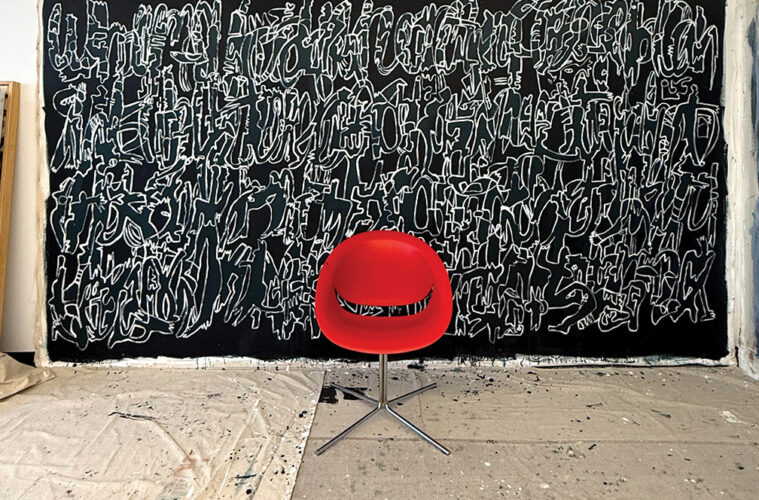
My favorite part of the painting process is that initial stage, the very beginning. Standing in front of a large, blank canvas, stapled to the wall, I feel completely free. I’m not attached to a plan or a goal. I let whatever is in my body and soul pour out of me, creating intuitive marks and words, written in a “stream of consciousness” flow.
After this early stage, I begin adding color and responding to the shapes and negative space of the marks and letters I have created. Often, I see figures in these beginning stages, and sometimes I bring them out. It is a constant process of construction and deconstruction. Using water, a spray bottle, and a scraper, I take layers of color and marks away, and often what is left behind is fascinating, and the process continues. I am also responding to the materials I use: the size of brush, the line of the graphite, charcoal or paint marker. At this point, the words and initial marks have completely morphed under layers of color, new marks, shapes and lines.
 Music, movement, and presence play an important role in your process. How do you create the conditions that allow you to work intuitively, and how does that sense of flow guide your decision making as a piece unfolds?
For me, I feel the act of painting in my body, which is why I paint large, to allow for movement and gesture. So, the first way I create the conditions for intuitive flow is by stapling a large piece of raw canvas to the wall (or sometimes a large wood panel will suffice.) Then, I grab all the paint, brushes, and mark making tools I might be using so that I don’t have to stop the flow as I’m working. Then, I turn on the music.
Music is my greatest source of inspiration. I feel as if I am painting a song and dancing a painting. I listen to everything: jazz, rap, hip-hop, classical, opera, folk, rock, EDM, etc. Each musical phrase, lyric, beat, instrument, rhythm, etc. evoke a response from me that is visceral. Music influences my color choice, my gestures, and my “dance” of the painting.
Another source of inspiration is a very powerful desire to express my emotional states. Whether it is a response to what is happening socially and politically in our world, or something personal, like grief or joy, the brush and paint simply become an extension of this pouring out of my emotions and ideas. Painting in this way allows me to tap into a state of flow where I am truly present in the moment.
 You were an educator for twenty-five years. How did your life as a teacher help you transition to full time artist? How has it shaped your approach to creativity, experimentation, and trust in the process?
This is such a teacher thing to say, but I learned early on in my teaching career that I had to be well prepared, daily. It was within the structure of preparedness that I found flexibility, freedom and intuition, which is I where I think the magic happens, both in the arts and teaching. Being prepared, then, is where this all began.
Approximately five years before I retired, I knew I wanted to come back to art. I took classes at Art Student League of Denver in the evenings and week-long studio courses at Anderson Ranch in Snowmass during the summers. I read books about my favorite artists and art theory, and I began attending artist talks and openings at non-profit art centers, museums and galleries. I wanted to learn as much as I could while I was still teaching so that when I retired, I was ready to go.
The other lesson I learned as a teacher, and there were so many, was to explore, take risks, and make mistakes, all without fear of judgment. Creating a classroom environment that was safe and allowed kids to express themselves was essential for me throughout the years. My master’s in education is Teaching Through the Arts, and I brought all forms of the arts, whether it was visual arts, movement, reader’s theater, poetry, music, building with a variety of materials, etc. into the classroom whenever possible. This deepened meaning and helped make connections, and it allowed students to express themselves creatively. Plus, it was fun! Usually, as some point in the creative process, things didn’t go perfectly as planned, and teaching kids that the frustration that comes along with trying something new is good, because that is when new learning takes place, as well as perseverance. This is a lesson I need to remember in my own studio practice all the time.
 Collaboration is a meaningful part of your practice, whether with other artists, students, or community members. Can you share a collaboration that deeply impacted you?
I love collaborating in the arts. It is difficult to pick just one, because all the collaborations I have done over the years with individual artists and communities have been incredible experiences. There are two collaborations I’d like to highlight.
My first studio was in Globeville, in the RiNo Arts district. It was here where I met Charlo. We became fast friends. He was just beginning his career as a muralist (and if you don’t know him already, look him up! His art career is incredible!) and I was just starting to show my work in a few group exhibitions around Denver. We were in the beginning stages of our artistic journeys, and we were interested in learning about each other’s process, so we decided to do an art session together. He brought his paint markers, and I had my paint and canvas. We are both intuitive artists, so creating together happened naturally. It was so easy and joyful, and there was no ego involved. I would paint over his marks, he would mark over the paint, and on and on it would go until we had created something entirely unique, together. Since then, we have exhibited our collaborations as well as sold a few. Every now and then, we continue to have studio sessions where we create together, and it is simply magical.
Another recent collaboration was with HOLDTIGHT, an interdisciplinary performance art company based here in Denver and NYC. Last spring, the incredibly talented founder and artistic director of HOLDTIGHT, Gwendolyn Hope Gussman, invited me to be a part of Wild Oscillations, an immersive dining experience at the restaurant Somebody People. This was unlike anything I had done before, and I loved it! This was truly multi-disciplinary, involving dance, live and original music, food, drinks, story, and visual art. I was painting live during these performances at the restaurant, responding intuitively to the music and the narrative, the food and the audience. The opportunity to integrate my art practice with the artists from HOLDTIGHT was a dream come true, and I am so grateful to them and Somebody People for creating this community experience through the arts.
Your work with Brent’s Place and Children’s Hospital involved creating alongside children and families during a challenging time in their lives. What did that experience teach you about art as a tool for connection, healing, and shared expression?
The opportunity to teach workshops and create art together at Brent’s Place came about by winning the Sharon Prize Grant, which provided the funds to make it all happen. The mural, Hearts of Hope, pictured in this article, was one of many artworks that came about from that collaboration.
I have always believed in the transformative power of creating art in community, where shared stories, connections and healing take place. My favorite part of this process was sitting at the table with the kids and families and creating art together. They let me come into their space during an incredibly difficult time, and it was I who received the greatest gift from them, by observing their courage, selflessness, love and hope. I am grateful and honored that they shared their stories and their strength with me.
What’s next on the horizon for you? Do you have any upcoming collaborations or exhibitions?
I’m honored to be part of a group exhibition at SeeSaw Gallery in Englewood celebrating the work of artists supported by the Sharon Prize grant. “Shared Visions: The Sharon Prize Artists” will be up through the end of this month, with a Performance Exhibition on February 28th.
Additionally, I will be the featured visual artist for Wonderbound, a contemporary ballet company and theater here in Denver, during their upcoming performance of Decadent Desires. My artwork, inspired by the choreography, story, and music for Decadent Desires, will be exhibited in the lobby gallery of the theater. Decadent Desires runs from February 26th – March 8th. Finally, my solo exhibition at SeeSaw Gallery will open in September. As soon as I’m finished installing the show at Wonderbound, work on this upcoming exhibition begins!
If you’d like to see more of Kristina’s work, we encourage you to visit her at www.kristinadaviesart.com or for an even more intimate look, via her instagram @kristinadaviesart. She also creates a lot of commission work for her audience. Check her out!