
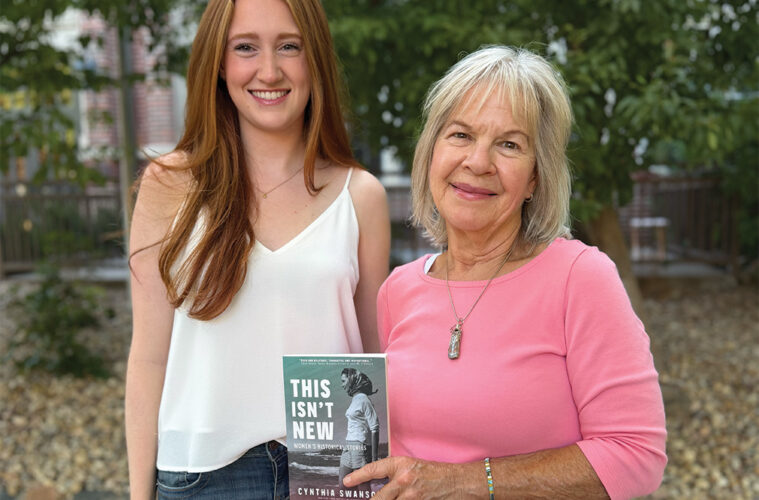
One of the best parts of living in Wash Park is discovering the incredible talent that exists just down the street. This month, we decided to do something a little different.
When University of Washington creative writing student, and Wash Park neighbor, Cara White asked to interview bestselling local author and neighbor Cynthia Swanson, we loved the idea. Their conversation began with Cara asking Cynthia about her newest book, This Isn’t New: Women’s Historical Stories. And somewhere along the way, Cynthia flipped the script to ask Cara about her own writing journey.
The result is a conversation between two neighbors connected by a shared love of storytelling, one an established, bestselling author, the other just beginning to write her own chapter.
Cara interviews Cynthia:
We’ve had the pleasure of speaking with you a few times, but can you tell us a bit about yourself for any new readers of the magazine?
I’m the New York Times and USA Today bestselling author of three novels: The Bookseller, The Glass Forest, and Anyone But Her, as well as a short story collection, This Isn’t New: Women’s Historical Stories. I’m also the editor of and a contributor to the anthology Denver Noir. I’ve lived in the Wash Park neighborhood for over 20 years.
You’ve just published This Isn’t New. What prompted the initial drafts of these stories? What inspired these women?
I wanted to use storytelling to explore the ways in which women historically have struggled with many of the same issues that we still face today: body image, gaslighting, abuse, gender presumptions, and more.
How did the process of drafting and editing the short stories differ from that of your three novels?
After I landed on a theme for the collection, I reviewed my short fiction catalog, both previously published and unpublished, and identified four existing stories to include. I edited those stories and also wrote five all-new stories. I worked on the stories in whatever order appealed to me – which didn’t end up being the order of the final collection.
This is a different process from writing a novel, which for me is linear, at least in a first draft. I might jump around during revision, but there’s still a long way to go before the novel is done. For the collection, I felt a huge sense of accomplishment each time I completed a story.
As a writer, you’re bound to grow attachments to your characters. Are there any in This Isn’t New that you’re especially fond of?
Francine is an 1880s theologian and the main character in the leadoff story, “In This World As in the Other.” Readers are introduced to two very different versions of Francine, but in both, she’s determined to live her life on her own terms. How that plays out depends greatly on forces beyond her control – something many readers can likely relate to.
How did you make sure each woman felt distinct in both her time period and personality?
The characters live during different eras and face discrete challenges, so I created a distinct world and its ensuing conflicts for each character. I also spread out the stories geographically. Three stories are set in Denver, but others are in the Midwest, Upstate New York, San Diego, and elsewhere.
For readers of my novels, there’s a story connected to each novel, either featuring a secondary character from the novel, or featuring an all-new character interacting with the novel’s characters. I hope my current readers will enjoy these “cookies,” and I hope new readers will check out my novels.
What was the most challenging aspect of writing a collection of short stories, and how did you push through?
Writing the collection was very rewarding, but convincing readers to give short fiction a try can be tough. Many fiction readers gravitate toward novels and might not think about exploring story collections. That being said, we’re all struggling with attention span these days, so I encourage readers to give short fiction a try. It could be a good way to get yourself past a reading slump, or simply to try something different.
If you had to assign a color palette to your book, what would that look like?
The cover design for This Isn’t New uses primarily teal and burgundy, colors that also are utilized for my other book covers (except for Denver Noir, which is part of a series from its publisher). For This Isn’t New, the varied women’s lives all have different color moods: blues, greens, pinks, yellows. Because the book is historical, monochrome is part of the mood, too. Most of the photos I used for research and inspiration (including the cover photo, which is a family photo) are black and white, since many of the stories take place before color photography existed.
What do you hope readers will take away from the book?
There’s power in storytelling to not only entertain, but also inspire and motivate. We’re at a pivotal moment in our country’s history, and the more we stand up and speak up, the better our chances of positive outcomes and wellbeing for our neighbors, families, and selves. We’ve faced tremendous setbacks, particularly in recent years. But I have faith that we can turn things around, and if This Isn’t New inspires even one reader, I consider that a success.
Are there any ideas floating around that you’d like to tackle next?
I’m currently revising my fourth novel, a mystery set in 1938, partially in Denver and partially in a fictional Grand County town. I set the novel aside to work on This Isn’t New, but now I’m hard at work on it again.
Where can readers learn more about you and your books?
My website is cynthiaswansonauthor.com, and I’m active on Substack (The What If Journal) and Instagram (cynswanauthor).
Then Cynthia asked Cara about her path as an emerging writer.
How did you become interested in creative writing? What most excites you about being a writer?
I haven’t ever really wanted to do anything else, a book may as well be my fifth limb. When I learned I could study creative writing as a career at the University of Washington, there was no hesitation to declare it as my major the minute I could.
Books have consistently been shaping my life, teaching me about power and love and even about myself. I want to impact people’s lives in the way other authors have impacted mine; to draw out that kind of emotion and passion in readers would be so rewarding.
What authors and/or books have most influenced your writing?
I had the obligatory Harry Potter and The Hunger Games phase, they are what really got me into reading and writing. More recently, reading The Picture of Dorian Gray has changed my writing style completely, and Kristin Hannah and Rachel Gillig have both become auto-buy authors. Every book I read, however, teaches me something, good and bad.
Is there a writing project you’ve done that you’re especially proud of? Tell us about it!
I have written a book! It’s a coming-of-age romance that I wrote my sophomore year of college. It follows five friends as they struggle to come into their identities while taking classes at the most prestigious university in North America. I’m still in the process of editing the first draft, and I don’t yet know if I will seek publication, but I am immensely proud of it. It was the first confirmation for me that I can really do this, if I work hard enough.
We love when these connections happen! Here’s to supporting independent writers.