
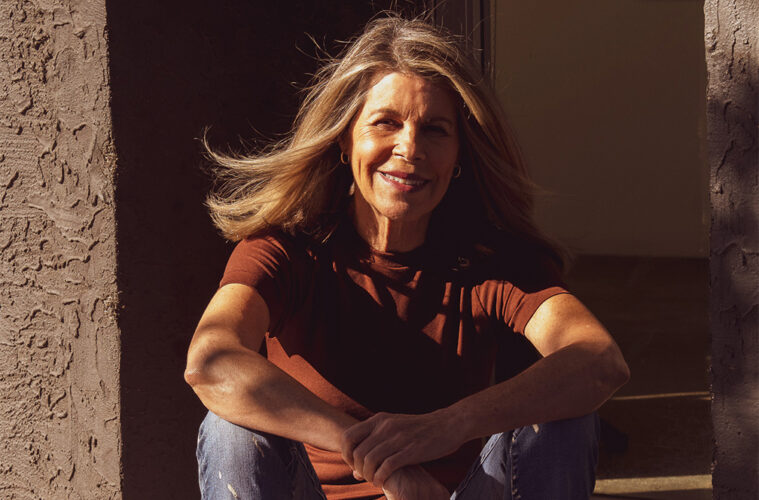
From the moment you step into Ana Quintana’s world, you feel it, movement, color, and a fearless embrace of the unexpected. Rooted in Wash Park, Ana has found her artistic voice through acrylic fluid art, a medium that mirrors her belief in living boldly and creating without hesitation. Working intuitively with her hands rather than brushes, she orchestrates pours of vibrant pigment, iridescent mica, and shifting layers that evolve in real time. The result is work that feels both spontaneous and intentional that invite you to experience the same thrill of discovery she feels with every pour.
Your journey has taken you from Cuba to the tech world and now into fluid art. What is one lesson from each of those chapters that you carry into your creative process today?
Resilience has shaped every chapter of my life. My parents and I came to the United States after the Cuban Revolution with very little, but through hard work and perseverance, we built a meaningful and successful life. Later, in the tech industry, I co-founded a consulting firm; an endeavor filled with risk and long hours that we eventually sold successfully.
Now, in this third chapter as a professional artist, that same resilience guides me. I show up to the studio daily, whether inspired or not, continually pushing the boundaries of fluid art and challenging myself to evolve rather than repeat what’s comfortable.
Fluid art is unpredictable by nature. Can you share a moment when a happy accident in your work turned into something truly special?
There are many approaches to fluid art, but I work strictly in the Shelee Art Bloom technique, developed in Australia. It’s a rigorous method with precise formulas and materials, yet it yields beautifully intricate, sophisticated designs. Instead of the traditional blow dryer or palette knife to disperse the cell activator (which is what disrupts the fluid acrylic paints and produces the cool effects), I began experimenting with compressed air. The result was unexpected; organic, branch-like forms and bold bubbles that, once popped, create striking, almost three-dimensional effects across the canvas.
Your studio practice sounds wonderfully immersive. Is there a ritual or habit you return to before starting a new piece that helps you get into a creative flow?
As a professional artist and a Christian, before I start a new project I begin with a prayer. I ask God to provide me with direction and inspiration and that the Holy Spirit will guide my hands so that what I create will bless others. While my paintings aren’t religious in nature, I rely on God to give me “nudges” regarding color stories, themes, subject matter, etc. Once a path feels right, I experiment with small test pieces before moving into larger canvases.
Wash Park has been your home for over two decades. How has living in this neighborhood influenced your work or the way you think about creativity and community?
I feel incredibly blessed to live in Wash Park East, especially on my particular block, where about ten neighboring families have truly become “family.” We travel together, host themed parties, and celebrate life’s milestones side by side. That deep sense of community has been essential to my creative journey, especially in my early years as an artist, when their encouragement meant everything.
Recently, I co-founded Artists of Wash Park, a collective of neighborhood artists united by place and purpose. Together, we share our work locally and create meaningful connections through art. You can currently find our exhibits and paintings for sale at Goudy’s Deli & Market on E. Alameda and at the Volunteer for Outdoor Colorado (VOC) building in the park. If you want to see more of our work or have us curate an exhibit for your business, contact us at www.artistsofwashpark.com
Many artists draw inspiration from specific places or memories. Is there a place, real or imagined, that you would love to explore in a future series?
For reasons I can’t fully explain, I’ve always felt drawn to the Arctic. That fascination led to a series titled Ice & Snow, where I explored luminous blues and icy palettes. Lately, my inspiration has shifted toward Japanese philosophies; Wabi-Sabi and Kintsugi among them. Their quiet reverence for imperfection and restoration feels like a beautiful counterbalance to the unpredictable, fluid nature of my medium. This year, I’m leaning fully into Japanese-inspired abstraction.
Your process seems to balance control and surrender. How do you decide when to guide the work and when to step back and let the materials lead?
Fluid art must be created in the moment. I have about 20 to 25 minutes before the paint stops moving. Once the pour begins, I can guide about half of what happens; the rest is up to the paint. I may start as the director, but eventually I surrender and let the medium speak.
For me, success lies in the preparation. The paint consistency must be precise, my custom pouring medium carefully mixed, the palette thoughtfully tested, and even the weather considered. By the time I begin, I’ve done small studies and refined my plan, but once the paint starts to flow, control gives way to collaboration.
What has been one of the most meaningful pieces or commissions you have created so far, and what made it stand out for you personally?
After a local magazine featured my work, I was invited by Cereset® to create a custom painting for their Cherry Creek office. They wanted a piece that visually reflected the essence of their work with the brain and nervous system. Cereset offers a unique wellness experience using patented BrainEcho® technology to help the brain relax and return to its natural balance.
The large painting I created, Mind Bloom, is my abstract interpretation of the nervous system and its intricate web of neurons. Fluid art felt like the perfect medium, allowing organic forms to unfold naturally across the canvas. My hope is that those who walk into the Cereset office feel a sense of wonder, curiosity, and quiet restoration when they encounter the piece.
When someone encounters your work for the first time, what feeling or takeaway do you hope stays with them after they walk away?
I hope viewers find the work beautiful, unique, and intriguing; wondering how it was created without a single paintbrush. I want each piece to feel alive and dynamic, something you can’t simply walk past – you have to stare it again and again. My favorite response is when someone sees something in the painting that I never noticed myself and proof that it continues to evolve with every new pair of eyes.
To learn more about Ana’s bold, unfiltered, and beautifully unpredictable art and involvement with the art community in Denver, visit her site at saintcrossart.com.